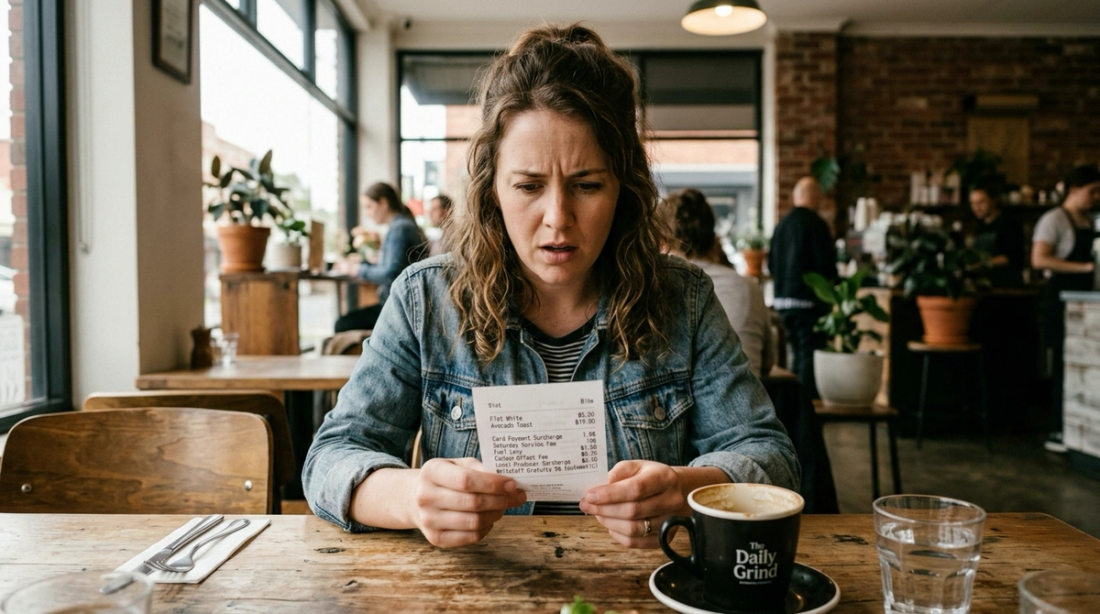
Just when we thought we'd seen every type of surcharge imaginable — a new one has entered the chat. And this time, it's not the 1.5% card fee you're used to grumbling about.
With the RBA's card surcharge ban locked in for 1 October 2026, you'd think dining out was about to get cheaper. No more sneaky percentage tacked onto the end of your brunch bill just because you tapped your phone. $1.6 billion a year in card surcharges — gone.
But here's the thing. Restaurants and cafes aren't sitting around waiting to lose revenue. They're getting creative. And your bill is starting to look... different.
The new breed of surcharges
A cracking piece from Good Food's Tomas Telegramma last month laid it all out. Beyond the familiar weekend and public holiday surcharges (which, fair enough, penalty rates are real), venues are now slapping on fees that make you squint at the EFTPOS machine and wonder what decade you're in.
“Discretionary” service charges — which is fancy talk for automatic tipping — are becoming standard at higher-end spots. Nel in Surry Hills tacks on a 10% service charge Fridays and Saturdays. House Made Hospitality's venues like Lana add up to 7%, removable “upon request.” (Good luck being the person at the table who asks for it to be taken off.)
Fuel levies. At an airport coffee shop. Veneziano Coffee at Melbourne Airport was recently found charging a 1% fuel levy that “applies daily.” A fuel levy. On a flat white.
Group dining fees. Booking for six or more? That'll be extra.
Late-night surcharges. Because apparently the kitchen gets more expensive after 9pm.
Why it matters
Here's the thing: none of this is illegal. The ACCC says businesses can set their own prices as long as they're transparent about it. And to their credit, most places do disclose these fees — somewhere. In the fine print. On a sign near the register. In the booking confirmation email you definitely read.
But for the average Melburnian just trying to grab dinner without needing a degree in forensic accounting, it's getting a bit much.
When the RBA's card surcharge ban kicks in on October 1, that 1–2% card fee disappears from your bill. That's genuinely good news — Australians are saving an estimated $1.6 billion a year. Small businesses collectively save another $910 million. Everyone wins, right?
Well, mostly. The question is whether “discretionary” service charges and creative new levies simply fill the gap. The card surcharge might vanish from your receipt, but suddenly there's a 7% “hospitality experience contribution” in its place.
What to actually do about it
Look, I'm not here to tell you to stop eating out. Life's too short, and Melbourne's too delicious.
But here's what I do: before booking anywhere new, I skim the fine print. If there's a service charge, I factor it into the total before I commit. If there's a weekend surcharge on a Saturday (when penalty rates are lower than Sundays), I raise an eyebrow. And if there's a fuel levy at an airport cafe... well, I'm probably already at the airport and out of options, so I take the L and move on.
The card surcharge ban is a win. No question. But the game of whack-a-mole between regulation and creative pricing isn't going anywhere.
So next time you're staring at a restaurant bill wondering where that extra $15 came from — it's probably not the card fee anymore. It's something new. Something creative. Something that definitely wasn't there last year.
Happy dining! ✌️
G