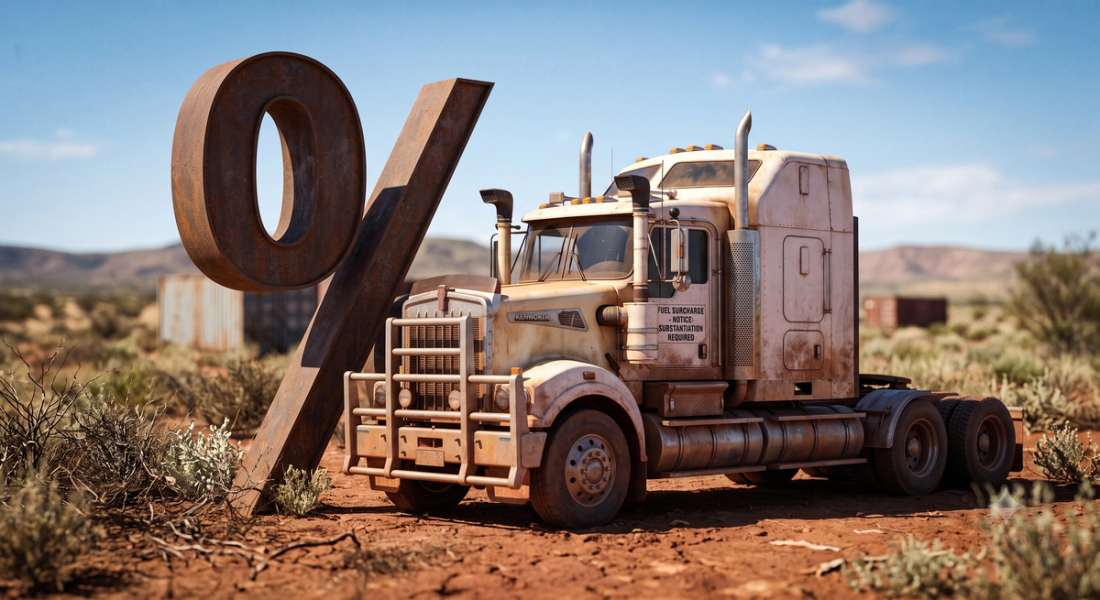
Just when you thought we'd seen every type of surcharge imaginable, the competition watchdog has dropped a number that made me do a double take: 70 per cent.
Not seven. Seventy.
That's how high some fuel surcharges have climbed in regional and remote Australia, according to the ACCC. And they're not having a bar of it.
What's happening?
The ACCC has fired off formal legal notices — called substantiation notices — to a string of businesses across South Australia, Western Australia, Queensland and the Northern Territory. These aren't polite requests for information. They carry legal weight. The businesses have three weeks to prove their sums add up, or they could be in serious bother.
ACCC Chair Gina Cass-Gottlieb put it bluntly: if a business is going to impose a surcharge, it must be able to substantiate it. In other words: show your working, mate.
And here's the kicker: the maximum penalty for misleading conduct has just doubled, from $50 million to $100 million. That's not a typo, and it's not a number any board takes lightly.
Where did these surcharges come from?
Fuel surcharges were originally meant to do one simple job: when diesel or petrol prices spike, a delivery company or service provider passes a slice of that extra cost on rather than swallowing it whole. Fair enough. Trucking freight across the Nullarbor or up to a remote NT community burns a lot of fuel.
But somewhere along the way, the fuel levy became one of the most fashionable add-ons in Australian commerce. It's not just on deliveries anymore — it's been popping up on bills from urban cafes, restaurants, and travel companies. A little line item here, a percentage there, and suddenly everyone's got a fuel problem.
The ACCC has noticed a spike in complaints from consumers and small operators who are copping these charges. And with maximum penalties now sitting at a cool $100 million, the watchdog has sharper teeth than ever.
The countdown to 1 October
Here's the thing that really gets me. We're now less than two months out from 1 October 2026 — the day card surcharges on eftpos, Mastercard, and Visa get the flick. American Express has even voluntarily joined the ban, which nobody really expected.
It should be a win for consumers. And in many ways, it is — $1.6 billion a year in card surcharges wiped off the checkout.
But nature abhors a vacuum, and so does Australian commerce. As card surcharges disappear, new fees are sliding into their place. Discretionary service charges at Melbourne restaurants. Automatic gratuity baked into the bill. Booking fees. Weekend surcharges (which, to be clear, aren't affected by the RBA's ban). And of course, the humble fuel levy, now doing double duty as a profit centre.
What the ACCC win means
The Mobil case earlier this year set the tone. The ACCC took Mobil to court and won, establishing that fuel surcharges need to be genuinely linked to actual fuel costs — not just whatever number looks good on a spreadsheet. The regulator also locked in five more years of formal fuel monitoring, publishing weekly price reports through to the end of September.
Now, with those beefed-up penalties and an extended monitoring program, the watchdog is sending a clear signal: the era of lazy surcharges is over.
Card surcharges are being banned. Fuel surcharges are being scrutinised. And if you're a business slapping on a fee without being able to back it up, you're about to have a very uncomfortable conversation.
My take
Look, I get it. Running a business is expensive. Fuel costs are genuinely higher than they were a few years ago, and someone has to pay. But 70 per cent? That's not cost recovery — that's a margin dressed up in hi-vis.
The 1 October ban on card surcharges is a genuinely good thing for Australian consumers. But if we're not careful, we'll just swap one set of dodgy fees for another. The ACCC's crackdown on fuel surcharges is the kind of enforcement we need — clear rules, real consequences, and a willingness to go after the worst offenders.
Here's hoping it sticks.
Stay sharp out there. G